NO APPEAL. THE RULING STANDS

A major victory for suppressor owners. The injunction is final, and a new purchase option is available for SilencerCo customers.

NFA ATF Court Ruling, Home Hero SICO
NFA ATF Court Ruling, Home Hero SICO - Mobile
ATF Guidance after Ruling

Oct 9th update from the ATF:

An open letter to all FFLs. The ATF will no longer require approval or registration to make or transfer suppressors

U.S. Department of Justice
Bureau of Alcohol, Tobacco, Firearms, and Explosives
Office of the Director

Open Letter to All Federal Firearms Licensees and the Public Regarding the National Firearms Act Making and Transfer Requirements for Certain Firearms and Devices

The purpose of this open letter is to notify all federal firearm licensees (FFLs) and the public of guidance from the Bureau of Alcohol, Tobacco, Firearms, and Explosives (ATF) regarding the applicability of certain provisions of National Firearms Act (NFA) to firearms that are no longer taxed pursuant to the One Big Beautiful Bill Act, Pub. L. No. 119-21, 139 Stat. 72 (2025). Congress reduced the transfer and making taxes to $0 in the One Big Beautiful Bill Act for certain weapons and devices. These include short-barreled rifles, short-barreled shotguns, silencers and “any other weapon[s]” as defined in 26 U.S.C. § 5845(e).

On August 5, 2026, a U.S. district judge in the Northern District of Texas enjoined ATF from enforcing certain provisions of the National Firearms Act (NFA), 26 U.S.C. ch. 53, effective August 12, 2026. See generally Silencer Shop Found. v. ATF, No. 6:25-CV-056-H, 2026 WL 2255460 (N.D. Tex. Aug. 5, 2026). Based on the reduction of the tax, the district court held that the NFA’s registration and transfer provisions were no longer an exercise of Congress’s taxing power with respect to those firearms. Id. at *1, *13–14. The district court also held that the challenged NFA provisions could not be upheld as an exercise of Congress’s power over interstate commerce because Congress did not rely on its power over interstate commerce when it first passed the NFA in 1934. Id. at *18–19.

The district court enjoined ATF from administering a variety of NFA provisions. These include the requirements to approve the making or transfer of firearms, the requirement to register all NFA firearms, and the associated criminal provisions for making, transferring, receiving, or possessing unregistered NFA firearms as applied to the $0 tax items. Id. at *30. The injunction applies only to the plaintiffs and to NFA firearms for which the One Big Beautiful Bill Act eliminated existing taxes. Id. at *31.

Since the district court’s injunction, ATF has received requests for guidance from litigants, Members of Congress, state Attorneys General, the industry, and the general public. Forty-seven Members of the U.S. House and Senate have also requested that ATF apply the ruling nationwide to all regulated parties.1 This open letter will provide an overview of the path forward, and it will be accompanied by a “Frequently Asked Questions” on ATF’s website that will provide more detail.

Although the district court’s injunction applies only to plaintiffs and certain other specified persons, the Department has determined to exercise its enforcement discretion to create greater uniformity, consistent with the Attorney General’s statement today. Consequently, effective October 9, 2026, ATF will no longer require individuals to seek ATF approval under the NFA before making or transferring short-barreled rifles, short-barreled shotguns, silencers, and “any other weapon[s]” as defined in 26 U.S.C. § 5845(e). ATF will also no longer require such items to be registered in the National Firearms Registration and Transfer Record. These policies apply uniformly to anyone otherwise subject to these requirements, not just to the plaintiffs in the litigation.

ATF will continue to administer the NFA on a voluntary basis. ATF will accept Form 1 applications to make or register these firearms and devices by those making such items. ATF will also accept Form 3 or Form 4 applications to transfer or register such items. Manufacturers are allowed to report the manufacture of these items on a Form 2.

Interested parties, however, should note five limits of this change in enforcement policy.

  1. First, the NFA still imposes special (occupational) taxes on any person engaged in the business of manufacturing, importing, or dealing in all NFA firearms and devices, including short-barreled rifles, short-barreled shotguns, silencers, and “any other weapon[s]” as defined in 26 U.S.C. § 5845(e). The district court’s injunction does not affect these taxes. Consequently, those engaged in the business must continue to pay applicable taxes on their businesses.

  2. Second, the injunction does not disturb the NFA’s application to machineguns and destructive devices. The One Big Beautiful Bill Act maintained the $200 tax on such items. Consequently, all NFA provisions still apply to machineguns and destructive devices.

  3. Third, the district court did not enjoin any provision of the Gun Control Act of 1968 (GCA). The GCA’s definition of “firearms” includes all firearms and suppressors and thus extends to short-barreled rifles, short-barreled shotguns, silencers, and “any other weapon[s].” Because these NFA firearms and devices are statutory “firearms” under the GCA, they may not be possessed by prohibited persons, and all recordkeeping and background check requirements under the GCA remain in place. See, e.g., 18 U.S.C. §§ 921(a)(3); id. § 922(d), (g), (n), (t); id. § 923(g); 27 C.F.R. § 478.121, et seq.

  4. Fourth, the district court did not enjoin the GCA’s restrictions on the transportation and sale of short-barreled rifles and short-barreled shotguns. See 18 U.S.C. § 922(a)(4), (b)(4). Individuals transporting short-barreled rifles and short-barreled shotguns should continue to file Form 20s, even if the firearms are not registered in the National Firearms Registration and Transfer Record. ATF is working as quickly as possible to issue new regulations to authorize federal firearms licensees to transfer short-barreled rifles and short-barreled shotguns under the GCA. In the interim, ATF will not enforce the provisions in 18 U.S.C. § 922(b)(4).

  5. Fifth, the district court’s injunction and the enforcement policy announced by this Open Letter do not affect state or local laws that govern NFA weapons. Most states have general criminal prohibitions on the possession of some or all NFA items. These laws often have exceptions for those NFA items possessed in compliance with or registered under federal law. Individuals, including dealers, should consult their local law enforcement authorities or seek legal advice for guidance on whether unregistered NFA items are lawful in their jurisdictions. Because interpretations of state law may vary, local authorities should also be contacted, or other advice sought, before transporting an unregistered NFA item into or through another jurisdiction. Additionally, it is unclear whether state courts will apply the safe harbor created by 18 U.S.C. § 926A to interstate transportation of unregistered NFA items. Consequently, individuals should exercise caution before transporting unregistered NFA items through states in which such items are prohibited by law, even if the items are not prohibited in the originating and destination states. The GCA also continues to prohibit federal firearm licensees from transferring statutory firearms in violation of state or local law. 18 U.S.C. § 922(b)(2). The GCA defines “firearm” to include all NFA items for which Congress eliminated the tax, including silencers. 18 U.S.C. § 921(a)(3).

Questions pertaining to this Open Letter should be directed toward ATF’s Firearms Industry Programs Branch (FIPB) at [email protected].
Robert Cekada
Director
Digitally signed October 9, 2026

ATF Frequently Asked Questions

So What Changed?

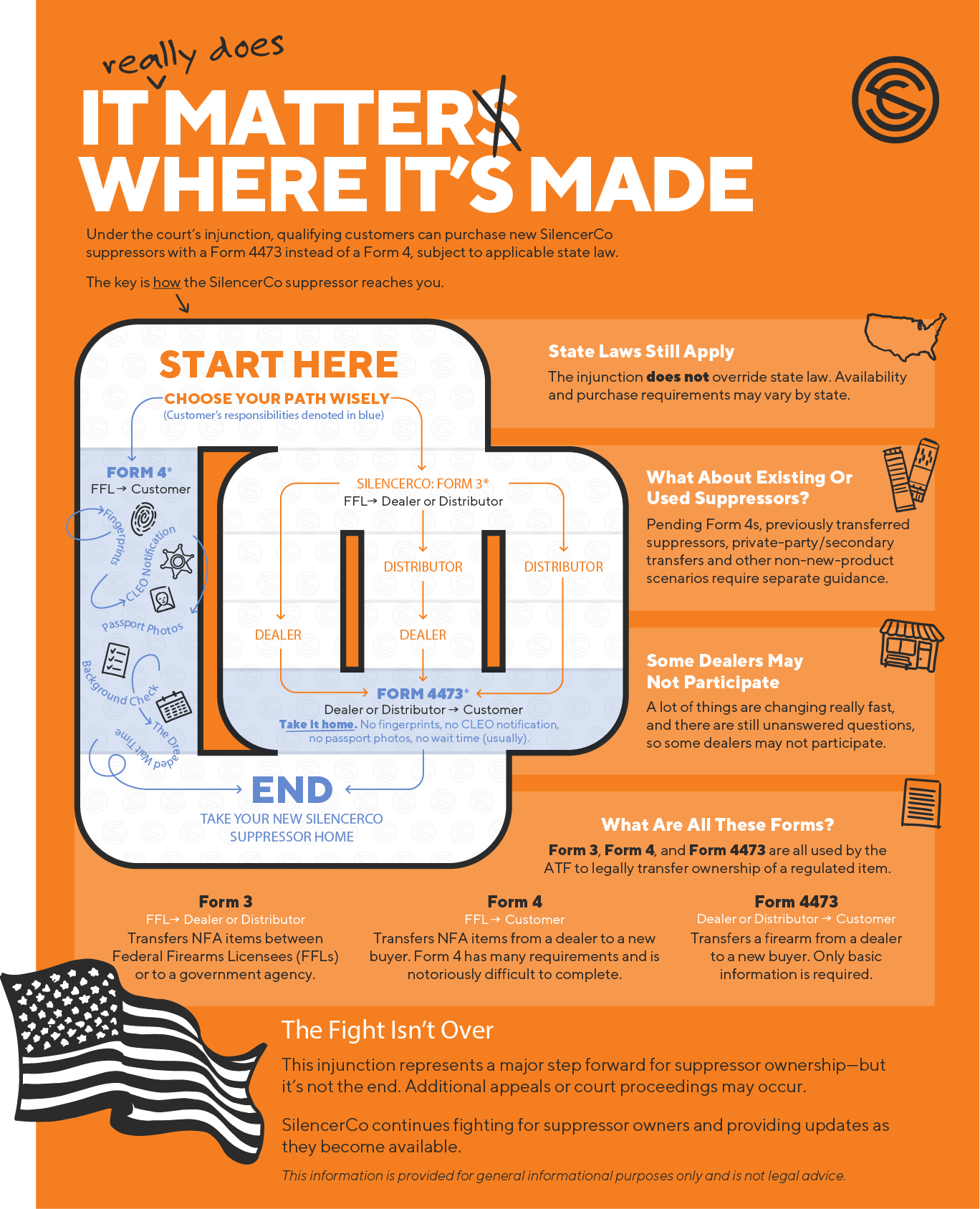
For qualifying SilencerCo purchases in 27 states, customers now have two potential paths:

FORM 4

Traditional NFA process, still available.

  • Fingerprints
  • Passport photo
  • CLEO notification
  • Background check
  • $0 tax stamp
  • ATF approval / wait time

FORM 4473

A new option, no Form 4 required.

  • No Form 4
  • No Fingerprints
  • No passport photo
  • No CLEO notification
  • NICS background check
  • Take possession after a satisfactory NICS result and dealer authorization 

Applicable States

The Form 4473 process is currently available in these 27 states:

– Alabama
– Arizona
– Arkansas
– Florida
– Idaho
– Indiana
– Iowa
– Kansas
– Kentucky
– Louisiana
– Maine
– Maryland
– Minnesota
– Missouri

– Nebraska
– New Hampshire
– New Mexico
– Oklahoma
– South Carolina
– South Dakota
– Tennessee
– Texas
– Utah
– Vermont
– Virginia
– West Virginia
– Wyoming

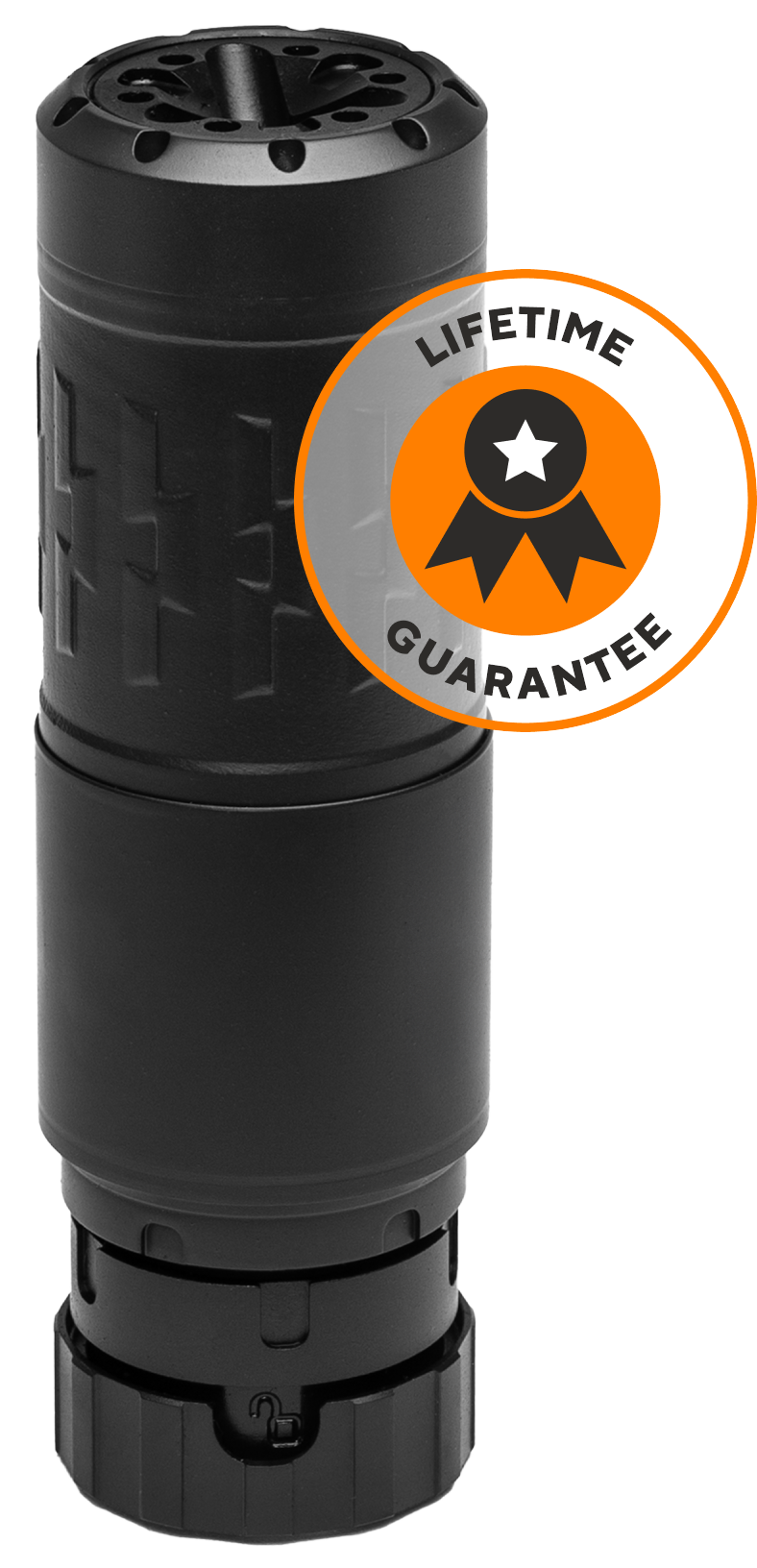
Suppressor warranty

What About my SilencerCo Warranty?

Nothing has changed about our commitment to your suppressor.

What About my SilencerCo Warranty?

Nothing has changed about our commitment to your suppressor.

• SilencerCo helped secure a major legal victory in a lawsuit challenging portions of the National Firearms Act (NFA).

• The court ruled on Aug 5th that the challenged NFA requirements exceed Congress’s constitutional authority as applied to untaxed firearms. The seven-day stay of the injunction expired as of August 13th.

• As a result, the government is blocked from enforcing the NFA provisions. The injunction is in effect! The defendants still have approximately two months from Aug 5th to appeal the decision.

BUYING WITH A FORM 4473

  1. Choose a new SilencerCo suppressor
    Visit a participating SilencerCo dealer in an applicable state.
  2. Complete Form 4473
    Just like a traditional firearm purchase.
  3. Complete the applicable background check process
    Your dealer handles the transaction and required paperwork.
  4. Receive authorization to proceed
    As with other firearm purchases, a NICS result can sometimes be delayed.
  5. Take your suppressor home
    No Form 4, fingerprints, passport photos or CLEO notification for the qualifying transaction.

FORM 4 ISN’T GOING AWAY

You can still choose the traditional Form 4 process.

A Form 4 may make sense if:

  • You want to use a trust.
  • You expect to travel or hunt outside your state with the suppressor.
  • Your dealer isn’t participating in Form 4473 transfers.
  • You prefer the established NFA registration process while questions surrounding the injunction continue to develop.

PLANNING TO TRAVEL?

There are still unresolved questions regarding interstate transportation of suppressors purchased using the Form 4473 process.

Until those questions are resolved, SilencerCo strongly encourages customers who purchase using Form 4473 to keep the suppressor in the state of purchase.

If you regularly hunt, compete or travel out of state, consider using the traditional Form 4 process.

IT REALLY DOES MATTER WHERE IT'S MADE

This win is huge. It’s also important to remember what it took to get here ↓

EXPLANATION OF THE LAWSUIT

The History:

  • Enacted in 1934, the National Firearms Act established a federal taxation and registration system for silencers and certain other regulated firearms.
    • The NFA’s registration, application and approval requirements were historically supported under Congress’s constitutional authority to collect taxes.
  • In 2025, Congress reduced the federal making and transfer taxes on silencers, short-barreled rifles, short-barreled shotguns and AOWs to zero. The tax change took effect January 1, 2026.
  • Although the applicable taxes were reduced to zero, the related registration and ATF approval requirements remained in place.

SilencerCo’s involvement:

  • SilencerCo Weapons Research, LLC joined Silencer Shop Foundation, the Firearms Regulatory Accountability Coalition (FRAC), and others in a lawsuit to challenge whether the federal government could continue enforcing those requirements under Congress’s taxing power when no associated taxes were being collected.
  • This was a coordinated effort involving multiple businesses, advocacy organizations, individual plaintiffs and 15 states.

WHAT DID THE COURT DECIDE?

The court entered final judgment in favor of the plaintiffs on their Article I enumerated-powers claims.

The court permanently blocked the ATF, Department of Justice and relevant federal officials from enforcing the challenged NFA provisions against the plaintiffs and, where applicable, their members and customers, including both current and future customers.

The decision applies to challenged provisions involving silencers, among other NFA-regulated items.

The court did not issue a universal nationwide injunction. The relief is limited to the plaintiffs, their customers, and other covered parties identified in the court’s Final Judgment.

The court resolved the case under Article I of the Constitution, and therefore opted not to consider whether the challenged requirements violate the Second Amendment.

THE CHANGE IS NOW IN EFFECT!

The federal government declined to seek an extension of the seven-day stay. The stay has now expired, and the injunction is in effect.  The government still has approximately 2 months to appeal the ruling.

This creates a pathway for qualifying SilencerCo suppressor transactions in most states to be completed without the traditional Form 4 registration and preapproval process. However, the injunction does not create a universal exemption from the NFA.

Dealers remain responsible for complying with all applicable federal, state and local laws. Below we describe our understanding of what this means:

  • Qualifying transactions will still be subject to applicable federal firearm requirements, including the standard Form 4473 and background-check process.
  • The injunction is not universal and does not apply to every suppressor, manufacturer, dealer, customer or transaction.
  • State and local laws governing suppressor purchases, possession and use remain in effect.
  • SilencerCo will continue to use Form 2 and Form 3 to ensure that dealers and customers can still utilize the Form 4 process where required or, if not required, where desired.
  • In states where state law allows, dealers may, if they choose, sell and transfer SilencerCo suppressors purchased directly from SilencerCo, or from an authorized distributor, to customers using the standard Form 4473 and applicable background check process rather than the Form 4 process. In filling out Form 4473 for suppressors, dealers should check “Other Firearm” in the appropriate box.
  • SilencerCo expects the ATF to continue to process Form 4s, including Form 4s already submitted and Form 4s submitted going forward, regardless of whether the Form 4 is required or not.

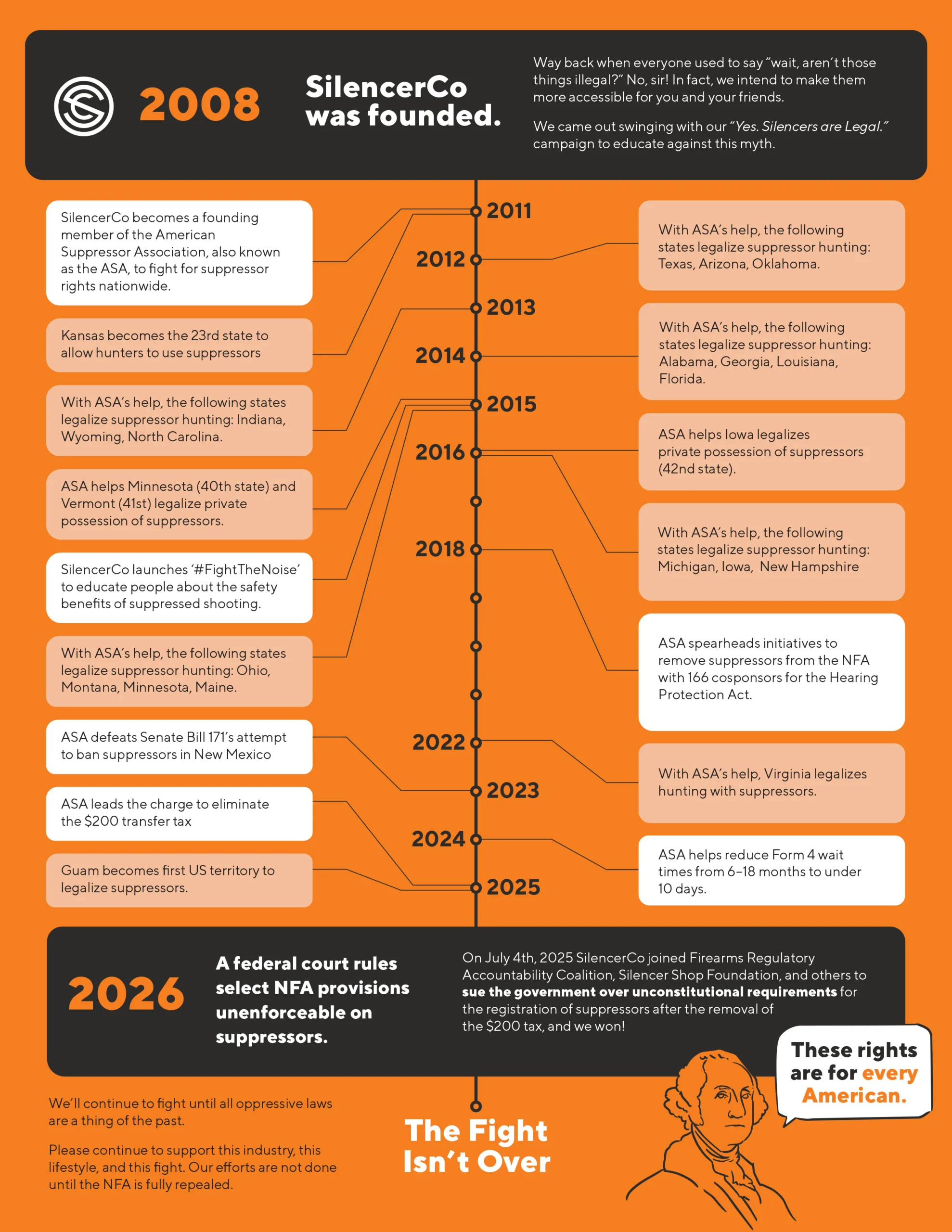
For 18 years, SilencerCo has fought shoulder to shoulder with our customers to make silencer ownership simpler, easier, and more common sense. We’ve challenged bad policy, taken on unnecessary regulation, and most recently helped secure a major legal victory against the ATF and DOJ.

But this fight was never just about business. It’s about individual liberty. It’s about protecting the sport and lifestyle we love. And it’s about making sure the next generation has the same opportunities we’ve had, and hopefully even more.

Silencers are easier to own today than they’ve ever been. The $200 tax is gone. Wait times are low. And we are closer than ever to removing regulations that never made sense in the first place. We’re not stopping now. Watch to see why we keep showing up, year after year, and why we’re finishing this thing together.

FREQUENTLY ASKED QUESTIONS

A: It depends. In states where state law allows, Dealers may, if they choose, sell and transfer SilencerCo suppressors purchased directly from SilencerCo, or from an authorized distributor, to customers using the standard Form 4473 and applicable background check process rather than the Form 4 process.

A: Continue following the existing process. Do not assume your pending application has been approved, canceled or made unnecessary.

A: No. The court did not issue a universal injunction. The relief applies to the plaintiffs and, where applicable, their members and current and future customers. Customer protection is also tied to qualifying transactions involving the commercial plaintiffs or applicable commercial members.

A: Do not assume that you are exempt. The court tied customer protection to qualifying transactions. It did not automatically exempt every NFA item a customer owns, transfers or possesses. You will still need to fill out a Form 4 (or form 4473 where applicable) in order to receive a suppressor.

A: That has not been determined. The decision could eventually affect federal paperwork, approvals and wait times for qualifying transactions, but the existing process remains in place today.

A: The federal defendants may seek appellate relief. An appeal or another legal action could affect when or whether the judgment is permanently implemented.

A: No. Consumers must continue following all state and local laws governing the purchase, possession and use of silencers and other regulated firearms.

A: Follow SilencerCo’s official website, email communications and social media channels. Be cautious of posts claiming that silencers are immediately available without the current ATF process.